Portrait of an Unknown Woman

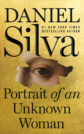
Gaoyou In a spellbinding new masterpiece by #1 New York Times–bestselling author Daniel Silva, Gabriel Allon undertakes a high-stakes search for the greatest art forger who ever lived.

Legendary spy and art restorer Gabriel Allon has at long last severed ties with Israeli intelligence and settled quietly in Venice, the only place he has ever truly known peace. His beautiful wife, Chiara, has taken over day-to-day management of the Tiepolo Restoration Company, and their two young children are clandestinely enrolled in a neighborhood scuola elementare. For his part, Gabriel spends his days wandering the streets and canals of the watery city, parting company with the demons of his tragic, violent past.

But when the eccentric London art dealer Julian Isherwood asks Gabriel to investigate the circumstances surrounding the rediscovery and lucrative sale of a centuries-old painting, he is drawn into a deadly game of cat and mouse where nothing is as it seems. 

Gabriel soon discovers that the work in question, a portrait of an unidentified woman attributed to Sir Anthony van Dyck, is almost certainly a fiendishly clever fake. To find the mysterious figure who painted it—and uncover a multibillion-dollar fraud at the pinnacle of the art world—Gabriel conceives one of the most elaborate deceptions of his career. If it is to succeed, he must become the very mirror image of the man he seeks: the greatest art forger the world has ever known.

Stylish, sophisticated, and ingeniously plotted, Portrait of an Unknown Woman is a wildly entertaining journey through the dirty side of the art world—a place where unscrupulous dealers routinely deceive their customers, and deep-pocketed investors treat great paintings as though they were just another asset class to be bought and sold at a profit. From its elegant opening passage to the shocking twists of its climax, the novel is a tour de force of storytelling and among the finest pieces of heist fiction ever written. And it is still more proof that, when it comes to international intrigue and suspense, Daniel Silva has no equal.

buy Ivermectin in uk Order Today:

amazon

bn

ibooks

Buy: HC.com

Share

An Excerpt of The Cellist

1

JERMYN STREET, ST. JAMES’S


Sarah Bancroft envied those fortunate souls who believed they controlled their own destinies. For them, life was no more complicated than riding the Underground. Insert your ticket at the fare gate, get off at the correct stop—Charing Cross rather than Leicester Square. Sarah had never subscribed to such drivel. Yes, one could prepare, one could strive, one could make choices, but ultimately life was an elaborate game of providence and probability. Regrettably, in matters of both work and love, she had displayed an uncanny lack of timing. She was either one step too fast or one too slow. She had missed many trains. Several times she had boarded the wrong one, nearly always with disastrous results.

Her latest career move appeared to fit this star-crossed pattern. Having established herself as one of the most prominent museum curators in New York, she had elected to relocate to London to take over day-to-day management of Isherwood Fine Arts, purveyors of quality Italian and Dutch Old Master paintings since 1968. True to form, her arrival was followed in short order by the outbreak of a deadly pandemic. Even the art world, which catered to the whims of the global superrich, was not immune to the contagion’s ravages. Almost overnight, the gallery’s business slipped into something approximating cardiac arrest. If the phone rang at all, it was usually a buyer or his representative calling to back out of a sale. Not since the West End musical version of Desperately Seeking Susan, declared Sarah’s acerbic mother, had London witnessed a less auspicious debut.

Isherwood Fine Arts had seen troubled times before—wars, terrorist attacks, oil shocks, market meltdowns, disastrous love affairs—and yet somehow it had always managed to weather the storm. Sarah had worked at the gallery briefly fifteen years earlier while serving as a clandestine asset of the Central Intelligence Agency. The operation had been a joint US-Israeli enterprise, run by the legendary Gabriel Allon. With the help of a lost Van Gogh, he had inserted Sarah into the entourage of a Saudi billionaire named Zizi al-Bakari and ordered her to find the terrorist mastermind lurking within it. Her life had never been the same since.

When the operation was over, she spent several months recuperating at an Agency safe house in the horse country of Northern Virginia. Afterward, she worked at the CIA’s Counterterrorism Center at Langley. She also took part in several joint American-Israeli operations, all at Gabriel’s behest. British intelligence was well aware of Sarah’s past, and of her presence in London—hardly surprising, for she was currently sharing a bed with an MI6 officer named Christopher Keller. Ordinarily, a relationship such as theirs was strictly forbidden, but in Sarah’s case an exception had been made. Graham Seymour, the director-general of MI6, was a personal friend, as was Prime Minister Jonathan Lancaster. Indeed, not long after her arrival in London, Sarah and Christopher had dined privately at Number Ten.

With the exception of Julian Isherwood, owner of the enchanted gallery that bore his name, the denizens of London’s art world knew none of this. As far as Sarah’s colleagues and competitors were concerned, she was the beautiful and brilliant American art historian who had briefly brightened their world one dreary winter long ago, only to throw them over for the likes of Zizi al-Bakari, may he rest in peace. And now, after a tumultuous journey through the secret world, she had returned, thus proving her point about providence and probability. At long last, Sarah had caught the right train.

London had welcomed her with open arms and with few questions asked. She scarcely had time to put her affairs in order before the virus invaded. She contracted the bug in early March at the European Fine Art Fair in Maastricht and had promptly infected both Julian and Christopher. Julian spent a dreadful fortnight at University College Hospital. Sarah was spared the worst of the virus’s symptoms but endured a month of fever, fatigue, headache, and shortness of breath that seized her each time she crawled from her bed. Not surprisingly, Christopher escaped unscathed and asymptomatic. Sarah punished him by forcing him to wait on her hand and foot. Somehow their relationship survived.

In June, London awakened from the lockdown. After thrice testing negative for the virus, Christopher returned to duty at Vauxhall Cross, but Sarah and Julian waited until Midsummer Day before reopening the gallery. It was located in a tranquil quadrangle of paving stones and commerce known as Mason’s Yard, between the offices of a minor Greek shipping company and a pub that in the innocent days before the plague had been frequented by pretty office girls who rode motor scooters. On the uppermost floor was a glorious exhibition room modeled on Paul Rosenberg’s famous gallery in Paris, where Julian had spent many happy hours as a child. He and Sarah shared a large office on the second floor with Ella, the attractive but useless receptionist. During their first week back in business, the phone rang just three times. Ella allowed all three calls to go to voice mail. Sarah informed her that her services, such as they were, were no longer necessary.

There was no point in hiring a replacement. The experts were warning of a vicious second wave when the weather turned cold, and London’s shopkeepers had been advised to expect more government-mandated lockdowns. The last thing Sarah needed was another mouth to feed. She resolved not to let the summer go to waste. She would sell a painting, any painting, even if it killed her.

She found one, quite by accident, while taking inventory of the catastrophically large number of unsold works in Julian’s bulging storerooms: The Lute Player, oil on canvas, 152 by 134 centimeters, perhaps early Baroque, quite damaged and dirty. The original receipt and shipping records were still lodged in Julian’s archives, along with a yellowed copy of the provenance. The earliest known owner was a Count So-and-So from Bologna, who in 1698 sold it to Prince Such-and-Such of Liechtenstein, who in turn sold it to Baron What’s-His-Name of Vienna, where it remained until 1962, when it was acquired by a dealer in Rome, who eventually unloaded it onto Julian. The painting had been attributed variously to the Italian School, a follower of Caravaggio, and, more promisingly, to the circle of Orazio Gentileschi. Sarah had a hunch. She showed the work to the learned Niles Dunham of the National Gallery during the three-hour period Julian reserved daily for his luncheon. Niles tentatively accepted Sarah’s attribution, pending additional technical examination utilizing X-radiography and infrared reflectography. He then offered to take the painting off Sarah’s hands for eight hundred thousand pounds.

“It’s worth five million, if not more.”

“Not during the Black Death.”

“We’ll see about that.”

Typically, a newly discovered work by a major artist would be brought to market with great fanfare, especially if the artist had seen a recent surge in popularity owing to her tragic personal story. But given the current volatility of the market—not to mention the fact that the newly discovered painting had been discovered in his own gallery—Julian decided a private sale was in order. He rang several of his most reliable customers and received not so much as a nibble. At which point Sarah quietly contacted a billionaire collector who was a friend of a friend. He expressed interest, and after several socially distant meetings at his London residence they arrived at a satisfactory price. Sarah requested a down payment of one million pounds, in part to cover the cost of the restoration, which would be extensive. The collector asked her to come to his dwelling at eight that evening to take delivery of the check.

All of which went some way to explaining why Sarah Bancroft, on a wet Wednesday evening in late July, was seated at a corner table in the bar of Wilton’s Restaurant in Jermyn Street. The mood in the room was uncertain, the smiles forced, the laughter uproarious but somehow false. Julian was tilted against the end of the bar. With his Savile Row suit and plentiful gray locks, he cut a rather elegant if dubious figure, a look he described as dignified depravity. He was peering into his Sancerre and pretending to listen to something that Jeremy Crabbe, the director of the Old Master department at Bonhams, was murmuring excitedly into his ear. Amelia March of ARTNews was eavesdropping on a conversation between Simon Mendenhall, the mannequin-like chief auctioneer from Christie’s, and Nicky Lovegrove, art adviser to the criminally rich. Roddy Hutchinson, widely regarded as the most unscrupulous dealer in all of London, was tugging at the sleeve of tubby Oliver Dimbleby. But Oliver seemed not to notice, for he was pawing at the impossibly beautiful former fashion model who now owned a successful modern art gallery in King Street. On her way out the door, she blew Sarah a decorous kiss with those perfect crimson lips of hers. Sarah sipped her three-olive martini and whispered, “Bitch.”

“I heard that!” Fortunately, it was only Oliver. Encased in a form-fitting gray suit, he floated toward Sarah’s table like a barrage balloon and sat down. “What have you got against the lovely Miss Watson?”

“Her eyes. Her cheekbones. Her hair. Her boobs.” Sarah sighed. “Shall I go on?”

Oliver waved his pudgy little hand dismissively. “You’re much prettier than she is, Sarah. I’ll never forget the first time I saw you walking across Mason’s Yard. Nearly stopped my heart. If memory serves, I made quite a fool of myself back then.”

“You asked me to marry you. Several times, in fact.”

“My offer still stands.”

“I’m flattered, Ollie. But I’m afraid it’s out of the question.”

“Am I too old?”

“Not at all.”

“Too fat?”

She pinched his pinkish cheek. “Just right, actually.”

“So what’s the problem?”

“I’m involved.”

“In what?”

“A relationship.”

He seemed unfamiliar with the word. Oliver’s romantic entanglements rarely lasted more than a night or two. “Are you talking about that bloke who drives the flashy Bentley?”

Sarah sipped her drink.

“What’s his name, this boyfriend of yours?”

“Peter Marlowe.”

“Sounds made up.”

With good reason, thought Sarah.

“What’s he do for a living?” blurted Oliver.

“Can you keep a secret?”

“My darling Sarah, I have more dirty secrets stored inside my head than MI5 and MI6 combined.”

She leaned across the table. “He’s a professional assassin.”

“Really? Interesting work, is it?”

Sarah smiled. It wasn’t true, of course. It had been several years since Christopher worked as a contract killer.

“Is he the reason you came back to London?” probed Oliver.

“One of the reasons. The truth is, I missed you all terribly. Even you, Oliver.” She checked the time on her phone. “Oh, hell! Will you be a love and pay for my drink? I’m late.”

“For what?”

“Behave, Ollie.”

“Why on earth would I want to do that? It’s so bloody boring.”

Sarah rose and, winking at Julian, went into Jermyn Street. The rain was suddenly coming down in torrents, but a taxi soon came to her rescue. She waited until she was safely inside before giving the driver the address of her destination.

“Cheyne Walk, please. Number forty-three.”


2

CHEYNE WALK, CHELSEA


Like Sarah Bancroft, Viktor Orlov believed that life was a journey best taken without aid of a map. Raised in an unheated Moscow apartment shared by three families, he became a billionaire many times over through a combination of luck, determination, and ruthless tactics that even his apologists described as unscrupulous, if not criminal. Orlov made no secret of the fact that he was a predator and a robber baron. Indeed, he wore those labels proudly. “Had I been born an Englishman, my money might have come to me cleanly,” he dismissively told a British interviewer after taking up residence in London. “But

I was born a Russian. And I earned a Russian fortune.”

In point of fact, Viktor Orlov was born a citizen not of Russia but of the Soviet Union. A brilliant mathematician, he attended the prestigious Leningrad Institute of Precision Mechanics and Optics and then disappeared into the Soviet nuclear weapons program, where he designed multiwarhead intercontinental ballistic missiles. Later, when asked why he had joined the Communist Party, he admitted it was for reasons of career advancement only. “I suppose I could have become a dissident,” he added, “but the gulag never seemed like a terribly appealing place to me.”

As a member of the pampered elite, Orlov witnessed the decay of the Soviet system from the inside and knew it was only a matter of time before the empire collapsed. When the end finally came, he renounced his membership in the Communist Party and vowed to become rich. Within a few years he had earned a sizable fortune importing computers and other Western goods for the nascent Russian market. He then used that fortune to acquire Russia’s largest state-owned steel company and Ruzoil, the Siberian oil giant. Before long, Orlov was the richest man in Russia.

But in post-Soviet Russia, a land with no rule of law, Orlov’s fortune made him a marked man. He survived at least three attempts on his life and was rumored to have ordered several men killed in retaliation. But the greatest threat to Orlov would come from the man who succeeded Boris Yeltsin as president. He believed that Viktor Orlov and the other oligarchs had stolen the country’s most valuable assets, and it was his intention to steal them back. After settling into the Kremlin, the new president summoned Orlov and demanded two things: his steel company and Ruzoil. “And keep your nose out of politics,” he added ominously. “Otherwise, I’ll cut it off.”

Orlov agreed to relinquish his steel interests, but not Ruzoil. The president was not amused. He immediately ordered prosecutors to open a fraud-and-bribery investigation, and within a week they had issued a warrant for Orlov’s arrest. He wisely fled to London, where he became one of the Russian president’s most vocal critics. For several years, Ruzoil remained legally icebound, beyond the reach of both Orlov and the new masters of the Kremlin. Orlov finally agreed to surrender the company in exchange for three Israeli intelligence agents held captive in Russia. One of the agents was Gabriel Allon.

For his generosity, Orlov received a British passport and a private meeting with the Queen at Buckingham Palace. He then embarked on an ambitious effort to rebuild his lost fortune, this time under the watchful eye of British regulatory officials, who monitored his every trade and investment. His empire now included such venerable London newspapers as the Independent, the Evening Standard, and the Financial Journal. He had also acquired a controlling interest in the Russian investigative weekly Moskovskaya Gazeta. With Orlov’s financial support, the magazine was once again Russia’s most prominent independent news organization and a thorn in the side of the men in the Kremlin.

As a consequence, Orlov lived each day with the knowledge that the formidable intelligence services of the Russian Federation were plotting to kill him. His new Mercedes-Maybach limousine was equipped with security features normally reserved for the state cars of presidents and prime ministers, and his home in Chelsea’s historic Cheyne Walk was one of the most heavily defended in London. A black Range Rover idled curbside, headlamps doused. Inside were four bodyguards, all former commandos from the elite Special Air Service employed by a discreet private security firm based in Mayfair. The one behind the wheel raised a hand in acknowledgment as Sarah alighted from the back of the taxi. Evidently, she was expected.

Number 43 was tall and narrow and covered in wisteria. Like its neighbors, it was set back from the street, behind a wrought-iron fence. Sarah hurried up the garden walk beneath the meager shelter offered by her compact umbrella. The bell push produced a resonant tolling within, but no response. Sarah pressed the button a second time, with the same result.

Typically, a maid would have answered the door. But Viktor, a notorious germophobe even before the pandemic, had slashed the hours of his household staff to reduce his odds of contracting the virus. A lifelong bachelor, he spent most evenings in his study on the third floor, sometimes alone, often with inappropriately young female company. The curtains were aglow with lamplight. Sarah reckoned he was on a call. At least, she hoped he was.

She rang the bell a third time and, receiving no answer, laid her forefinger on the biometric reader next to the door. Viktor had added her fingerprint to the system, no doubt with the hope their relationship might continue after the sale of the painting was complete. An electronic chirp informed Sarah that the scan had been accepted. She entered her personal passcode—it was identical to the one she used at the gallery—and the deadbolts snapped open at once.

She lowered her umbrella, twisted the doorknob, and went inside. The silence was absolute. She called Viktor’s name but there was no reply. Crossing the entrance hall, she mounted the grand staircase and climbed to the third floor. The door of Viktor’s study was ajar. She knocked. No answer.

Calling Viktor’s name, she entered the room. It was an exact replica of the Queen’s private study in her apartment at Buckingham Palace—all except for the high-definition video wall that flickered with financial newscasts and market data from around the world. Viktor was seated behind his desk, his face tilted toward the ceiling, as though he were deep in thought.

When Sarah approached the desk, he made no movement. Before him was the receiver from his landline telephone, a half-drunk glass of red wine, and a stack of documents. His mouth and chin were covered in white foam, and there was vomit on the front of his striped dress shirt. Sarah saw no evidence of respiration.

“Oh, Viktor. Dear God.”

While at the CIA, Sarah had worked cases involving weapons of mass destruction. She recognized the symptoms. Viktor had been exposed to a nerve agent.

In all likelihood, so had Sarah.

She rushed from the room, her hand to her mouth, and hurried down the staircase. The wrought-iron gate, the bell push, the biometric scanner, the keypad: any one of them could have been contaminated. Nerve agents were extremely fast acting. She would know in a minute or two.

Sarah touched one final surface, the knob on Viktor’s leaden front door. Outside, she lifted her face to the falling rain and waited for the first telltale rush of nausea. One of the bodyguards clambered from the Range Rover, but Sarah warned him to approach no closer. Then she dug her phone from her handbag and dialed a number from her preferred contacts. The call went straight to voice mail. As usual, she thought, her lack of timing was impeccable.

“Forgive me, my love,” she said calmly. “But I’m afraid I might be dying.”

Share

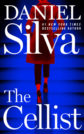
The Cellist

An instant #1 New York Times bestseller!

Viktor Orlov had a longstanding appointment with death. Once Russia’s richest man, he now resides in splendid exile in London, where he has waged a tireless crusade against the authoritarian kleptocrats who have seized control of the Kremlin. His mansion in Chelsea’s exclusive Cheyne Walk is one of the most heavily protected private dwellings in London. Yet somehow, on a rainy summer evening, in the midst of a global pandemic, Russia’s vengeful president finally manages to cross Orlov’s name off his kill list.

Before him was the receiver from his landline telephone, a half-drunk glass of red wine, and a stack of documents.…

The documents are contaminated with a deadly nerve agent. The Metropolitan Police determine that they were delivered to Orlov’s home by one of his employees, a prominent investigative reporter from the anti-Kremlin Moskovskaya Gazeta. And when the reporter slips from London hours after the killing, MI6 concludes she is a Moscow Center assassin who has cunningly penetrated Orlov’s formidable defenses.

But Gabriel Allon, who owes his very life to Viktor Orlov, believes his friends in British intelligence are dangerously mistaken. His desperate search for the truth will take him from London to Amsterdam and eventually to Geneva, where a private intelligence service controlled by a childhood friend of the Russian president is using KGB-style “active measures” to undermine the West from within. Known as the Haydn Group, the unit is plotting an unspeakable act of violence that will plunge an already divided America into chaos and leave Russia unchallenged. Only Gabriel Allon, with the help of a brilliant young woman employed by the world’s dirtiest bank, can stop it.

Elegant and sophisticated, provocative and daring, The Cellist explores one of the preeminent threats facing the West today—the corrupting influence of dirty money wielded by a revanchist and reckless Russia. It is at once a novel of hope and a stark warning about the fragile state of democracy. And it proves once again why Daniel Silva is regarded as his generation’s finest writer of suspense and international intrigue.


Order Today:

amazon

bn

ibooks

Buy: HC.com

Share

Praise for The Order

“Can’t put it down. Won’t put it down. I’m fully and enthralled by Daniel Silva’s The Order.
— Bob Woodward

“A refreshingly hopeful thriller for troubled times… Silva’s latest broad-canvas thriller starring the much-loved Gabriel Allon will quickly take its reserved seat atop most best-seller lists.”
— Booklist (starred review)

“Relevant and compelling…Engaging and deftly paced, another thoughtfully entertaining summer read from Silva.”
Kirkus (starred review)

“Pulse-pounding…. [Silva] proves to be a master weaver of tales of international espionage and assassinations. One cannot help but marvel at his uncanny prescient knowledge of events unfolding today and those of tomorrow.”
—The Times of Israel

“Silva once again reminds readers why he’s one of the most gifted novelists of our time with his latest must-read thriller…As always, his attention to detail and unmatched ability to paint words on the page bring each location to life in a way that’s stunningly cinematic. In many ways, reading one of Mr. Silva’s books is like a vacation in itself…Timely, fast-paced, and impossible to put down, The Order makes one thing absolutely clear…if you’re not reading Daniel Silva, you’re missing out on one of the greatest, most prolific novelists the genre has ever known.”
The Real Book Spy

Share

Read an excerpt of The Order

1: ROME


The call arrived at 11:42 p.m. Luigi Donati hesitated before answering. The number displayed on the screen of his telefonino belonged to Albanese. There was only one reason why he would ring at such an hour.

“Where are you, Excellency?”

“Outside the walls.”

“Ah, yes. It’s a Thursday, isn’t it?”

“Is there a problem?”

“Better not to say too much on the phone. One never knows who might be listening.”

The night into which Donati stepped was damp and cold. He was dressed in a black clerical suit and Roman collar, not the fuchsia-trimmed cassock and simar he wore around the office, which was how men of his ecclesiastical rank referred to the Apostolic Palace. An archbishop, Donati served as private secretary to His Holiness Pope Paul VII. Tall and lean, with rich dark hair and movie-idol features, he had recently celebrated his sixty-third birthday. Age had done nothing to diminish his good looks. Vanity Fair magazine had recently christened him “Luscious Luigi.” The article had caused him no end of embarrassment inside the backbiting world of the Curia. Still, given Donati’s well-deserved reputation for ruthlessness, no one had dared to mention it to his face. No one but the Holy Father, who had teased him mercilessly.

Better not to say too much on the phone…

Donati had been preparing himself for this moment for a year or more, ever since the first mild heart attack, which he had concealed from the rest of the world and even much of the Curia. But why tonight of all nights?

The street was oddly quiet. Deathly quiet, thought Donati suddenly. It was a palazzo-lined avenue just off the Via Veneto, the sort of place a priest rarely set foot—especially a priest educated and trained by the Society of Jesus, the intellectually rigorous and sometimes rebellious order to which Donati belonged. His official Vatican car, with its SCV license plates, waited curbside. The driver was from the Corpo della Gendarmeria, the Vatican’s 130-member police force. He headed westward across Rome at an unhurried pace.

He doesn’t know…

On his mobile phone Donati scanned the websites of the leading Italian newspapers. They were in the dark. So were their colleagues in London and New York.

“Turn on the radio, Gianni.” “Music, Excellency?”

“News, please.”

It was more drivel from Saviano, another rant about how Arab and African immigrants were destroying the country, as if the Italians weren’t more than capable of making a fine mess of things themselves. Saviano had been badgering the Vatican for months about a private audience with the Holy Father. Donati, with no small amount of pleasure, had refused to grant it.

“That’s quite enough, Gianni.”

The radio went blessedly silent. Donati peered out the window of the luxury German-made sedan. It was no way for a Soldier of Christ to travel. He supposed this would be his final journey across Rome by chauffeured limousine. For nearly two decades he had served as something like the chief of staff of the Roman Catholic Church. It had been a tumultuous time—a terrorist attack on St. Peter’s, a scandal involving antiquities and the Vatican Museums, the scourge of priestly sexual abuse— and yet Donati had relished every minute of it. Now, in the blink of an eye, it was over. He was once again a mere priest. He had never felt more alone.

The car crossed the Tiber and turned onto the Via della Conciliazione, the broad boulevard Mussolini had carved through Rome’s slums. The floodlit dome of the basilica, restored to its original glory, loomed in the distance. They followed the curve of Bernini’s Colonnade to St. Anne’s Gate, where a Swiss Guard waved them onto the territory of the city-state. He was dressed in his night uniform: a blue tunic with a white schoolboy collar, knee-length socks, a black beret, a cape against the evening chill. His eyes were dry, his face untroubled.

He doesn’t know…

The car moved slowly up the Via Sant’Anna—past the barracks of the Swiss Guard, the church of St. Anne, the Vatican printing offices, and the Vatican Bank—before coming to a stop next to an archway leading to the San Damaso Courtyard. Donati crossed the courtyard on foot, boarded the most important lift in all of Christendom, and ascended to the third floor of the Apostolic Palace. He hurried along the loggia, a wall of glass on one side, a fresco on the other. A left turn brought him to the papal apartments.

Another Swiss Guard, this one in full dress uniform, stood straight as a ramrod outside the door. Donati walked past him without a word and went inside. Thursday, he was thinking. Why did it have to be a Thursday?


Eighteen years, thought Donati as he surveyed the Holy Father’s private study, and nothing had changed. Only the telephone. Donati had finally managed to convince the Holy Father to replace Wojtyla’s ancient rotary contraption with a modern multiline device. Otherwise, the room was exactly the way the Pole had left it. The same austere wooden desk. The same beige chair. The same worn Oriental rug. The same golden clock and crucifix. Even the blotter and pen set had belonged to Wojtyla the Great. For all the early promise of his papacy—the promise of a kinder, less repressive Church—Pietro Lucchesi had never fully escaped the long shadow of his predecessor.

Donati, by some instinct, marked the time on his wristwatch. It was 12:07 a.m. The Holy Father had retired to the study that evening at half past eight for ninety minutes of reading and writing. Ordinarily, Donati remained at his master’s side or just down the hall in his office. But because it was a Thursday, the one night of the week he had to himself, he had stayed only until nine o’clock.

Do me a favor before you leave, Luigi…

Lucchesi had asked Donati to open the heavy curtains covering the study’s window. It was the same window from which the Holy Father prayed the Angelus each Sunday at noon. Donati had complied with his master’s wishes. He had even opened the shutters so His Holiness could gaze upon St. Peter’s Square while he slaved over his curial paperwork. Now the curtains were tightly drawn. Donati moved them aside. The shutters were closed, too.

The desk was tidy, not Lucchesi’s usual clutter. There was a cup of tea, half empty, a spoon resting on the saucer, that had not been there when Donati departed. Several documents in manila folders were stacked neatly beneath the old retractable lamp. A report from the Archdiocese of Philadelphia regarding the financial fallout of the abuse scandal. Remarks for next Wednesday’s General Audience. The first draft of a homily for a forthcoming papal visit to Brazil. Notes for an encyclical on the subject of immigration that was sure to rile Saviano and his fellow travelers in the Italian far right.

One item, however, was missing.

You’ll see that he gets it, won’t you, Luigi?

Donati checked the wastebasket. It was empty. Not so much as a scrap of paper.

“Looking for something, Excellency?”

Donati glanced up and saw Cardinal Domenico Albanese eyeing him from the doorway. Albanese was a Calabrian by birth and by profession a creature of Curia. He held several senior positions in the Holy See, including president of the Pontifical Council for Interreligious Dialogue, and archivist and librarian of the Holy Roman Church. None of that, however, explained his presence in the papal apartments at seven minutes past midnight. Domenico Albanese was the camerlengo. It was his responsibility alone to issue the formal declaration that the throne of St. Peter was vacant.

“Where is he?” asked Donati.

“In the kingdom of heaven,” intoned the cardinal. “And the body?”

Had Albanese not heard the sacred calling, he might have moved slabs of marble for his living or hurled carcasses in a Calabrian abattoir. Donati followed him along a brief corridor, into the bedroom. Three more cardinals waited in the half-light: Marcel Gaubert, José Maria Navarro, and Angelo Francona. Gaubert was the secretary of state, effectively the prime minister and chief diplomat of the world’s smallest country. Navarro was prefect of the Congregation for the Doctrine of the Faith, guardian of Catholic orthodoxy, defender against heresy. Francona, the oldest of the three, was the dean of the College of Cardinals. As such, he would preside over the next conclave.

It was Navarro, a Spaniard of noble stock, who addressed Donati first. Though he had lived and worked in Rome for nearly a quarter century, he still spoke Italian with a pronounced Castilian accent. “Luigi, I know how painful this must be for you. We were his faithful servants, but you were the one he loved the most.”

Cardinal Gaubert, a thin Parisian with a feline face, nodded profoundly at the Spaniard’s curial bromide, as did the three laymen standing in the shadow at the edge of the room: Dr. Octavio Gallo, the Holy Father’s personal physician; Lorenzo Vitale, chief of the Corpo della Gendarmeria; and Colonel Alois Metzler, commandant of the Pontifical Swiss Guard. Donati, it seemed, was the last to arrive. It was he, the private secretary, who should have summoned the senior princes of the Church to the bedside of the dead pope, not the camerlengo. Suddenly, he was racked by guilt.

But when Donati looked down at the figure stretched upon the bed, his guilt gave way to overwhelming grief. Lucchesi was still wearing his white soutane, though his slippers had been removed and his zucchetto was nowhere to be seen. Someone had placed the hands upon the chest. They were clutching his rosary. The eyes were closed, the jaw slack, but there was no evidence of pain on his face, nothing to suggest he had suffered. Indeed, Donati would not have been surprised if His Holiness woke suddenly and inquired about his evening.

He was still wearing his white soutane…

Donati had been the keeper of the Holy Father’s schedule from the first day of his pontificate. The evening routine rarely varied. Dinner from seven to eight thirty. Paperwork in the study from eight thirty until ten, followed by fifteen minutes of prayer and reflection in his private chapel. Typically, he was in bed by half past ten, usually with an English detective novel, his guilty pleasure. Devices and Desires by P. D. James lay on the bedside table beneath his reading glasses. Donati opened it to the page marked.

Forty-five minutes later Rickards was back at the scene of the murder…

Donati closed the book. The supreme pontiff, he reckoned, had been dead for nearly two hours, perhaps longer. Calmly, he asked, “Who found him? Not one of the household nuns, I hope.”

“It was me,” replied Cardinal Albanese.

“Where was he?”

“His Holiness departed this life from the chapel. I discovered him a few minutes after ten. As for the exact time of his passing…” The Calabrian shrugged his heavy shoulders. “I cannot say, Excellency.”

“Why wasn’t I contacted immediately?”

“I searched for you everywhere.”

“You should have called my mobile.”

“I did. Several times, in fact. There was no answer.”

The Calabrian, thought Donati, was being untruthful. “And what were you doing in the chapel, Eminence?”

“This is beginning to sound like an inquisition.” Albanese’s eyes moved briefly to Cardinal Navarro before settling once more on Donati. “His Holiness asked me to pray with him. I accepted his invitation.”

“He phoned you directly?”

“In my apartment,” said the camerlengo with a nod.

“At what time?”

Albanese lifted his eyes to the ceiling, as though trying to recall a minor detail that had slipped his mind. “Nine fifteen. Perhaps nine twenty. He asked me to come a few minutes after ten. When I arrived…”

Donati looked down at the man stretched lifeless upon the bed. “And how did he get here?”

“I carried him.”

“Alone?”

“His Holiness bore the weight of the Church on his shoulders,” said Albanese, “but in death he was light as a feather. Because I could not reach you, I summoned the secretary of state, who in turn rang Cardinals Navarro and Francona. I then called Dottore Gallo, who made the pronouncement. Death by a massive heart attack. His second, was it not? Or was it his third?”

Donati looked at the papal physician. “At what time did you make the declaration, Dottore Gallo?”

“Eleven ten, Excellency.”

Cardinal Albanese cleared his throat gently. “I’ve made a slight adjustment to the timeline in my official statement. If it is your wish, Luigi, I can say that you were the one who found him.”

“That won’t be necessary.”

Donati dropped to his knees next to the bed. In life, the Holy Father had been elfin. Death had diminished him further. Donati remembered the day the conclave unexpectedly chose Lucchesi, the Patriarch of Venice, to be the two hundred and sixty-fifth supreme pontiff of the Roman Catholic Church. In the Room of Tears he had chosen the smallest of the three ready-made cassocks. Even so, he had seemed like a small boy wearing his father’s shirt. As he stepped onto the balcony of St. Peter’s, his head was barely visible above the balustrade. The vaticanisti christened him Pietro the Improbable. Church hardliners had referred to him derisively as Pope Accidental.

After a moment Donati felt a hand on his shoulder. It was like lead. Therefore, it had to be Albanese’s.

“The ring, Excellency.”

It was once the responsibility of the camerlengo to destroy the dead pope’s Ring of the Fisherman in the presence of the College of Cardinals. But like the three taps to the papal forehead with a silver hammer, the practice had been done away with. Lucchesi’s ring, which he seldom wore, would merely be scored with two deep cuts in the sign of the cross. Other traditions, however, remained in place, such as the immediate locking and sealing of the papal apartments. Even Donati, Lucchesi’s only private secretary, would be barred from entering once the body was removed.

Still on his knees, Donati opened the drawer of the bedside table and grasped the heavy golden ring. He surrendered it to Cardinal Albanese, who placed it in a velvet pouch. Solemnly, he declared, “Sede vacante.”

The throne of St. Peter was now empty. Canon law dictated that Cardinal Albanese would serve as temporary caretaker of the Roman Catholic Church during the interregnum, which ended with the election of a new pope. Donati, a mere titular archbishop, would have no say in the matter. In fact, now that his master was gone, he was without portfolio or power, answerable only to the camerlengo.

“When do you intend to release the statement?” asked Donati.

“I was waiting for you to arrive.”

“Might I review it?”

“Time is of the essence. If we delay any longer…”

“Of course, Eminence.” Donati placed his hand atop Lucchesi’s. It was already cold. “I’d like to have a moment alone with him.”

“A moment,” said the camerlengo.

The room slowly emptied. Cardinal Albanese was the last to leave.

“Tell me something, Domenico.”

The camerlengo paused in the doorway. “Excellency?” “Who closed the curtains in the study?”

“The curtains?”

“They were open when I left at nine. The shutters, too.”
“I closed them, Excellency. I didn’t want anyone in the square to see lights burning in the apartments so late.”

“Yes, of course. That was wise of you, Domenico.”

The camerlengo went out, leaving the door open. Alone with his master, Donati fought back tears. There would be time for grieving later. He leaned close to Lucchesi’s ear and gently squeezed the cold hand. “Speak to me, old friend,” he whispered. “Tell me what really happened here tonight.”

Share

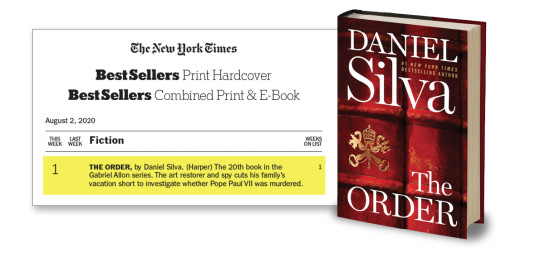
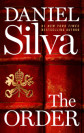
The Order

NOW IN PAPERBACK

The Order is a #1 New York Times Bestseller

 It was nearly one a.m. by the time he crawled into bed. Chiara was reading a novel, oblivious to the television, which was muted. On the screen was a live shot of St. Peter’s Basilica. Gabriel raised the volume and learned that an old friend had died …

Gabriel Allon has slipped quietly into Venice for a much-needed holiday with his wife and two young children. But when Pope Paul VII dies suddenly, Gabriel is summoned to Rome by the Holy Father’s loyal private secretary, Archbishop Luigi Donati. A billion Catholic faithful have been told that the pope died of a heart attack. Donati, however, has two good reasons to suspect his master was murdered. The Swiss Guard who was standing watch outside the papal apartments the night of the pope’s death is missing. So, too, is the letter the Holy Father was writing during the final hours of his life. A letter that was addressed to Gabriel.

While researching in the Vatican Secret Archives, I came upon a most remarkable book …

The book is a long-suppressed gospel that calls into question the accuracy of the New Testament’s depiction of one of the most portentous events in human history. For that reason alone, the Order of St. Helena will stop at nothing to keep it out of Gabriel’s hands. A shadowy Catholic society with ties to the European far right, the Order is plotting to seize control of the papacy. And it is only the beginning.

As the cardinals gather in Rome for the start of the conclave, Gabriel sets out on a desperate search for proof of the Order’s conspiracy, and for a long-lost gospel with the power to put an end to two thousand years of murderous hatred. His quest will take him from the Ponte Vecchio in Florence, to a monastery in Assisi, to the hidden depths of the Secret Archives, and finally to the Sistine Chapel, where he will witness an event no outsider has ever before seen—the sacred passing of the Keys of St. Peter to a newly elected pope.

Swiftly paced and elegantly rendered, The Order will hold readers spellbound, from its opening passages to its breathtaking final twist of plot. It is a novel of friendship and faith in a perilous and uncertain world. And it is still more proof that Daniel Silva is his generation’s finest writer of suspense and international intrigue.


Order Today:

amazon

bn

ibooks

Buy: HC.com

Share

Praise for The New Girl

“An irresistible thriller, built on the realpolitik of today’s Middle East but deepened by the universality of human tragedy.”
Booklist (starred review)

“Sophisticated…As always, Silva delivers sharply drawn characters, a complex plot, and vivid backgrounds that add to the book’s realism…an excellent introduction for new readers.”
Publishers Weekly

“It’s hard to fathom that Silva could ever top himself after last year’s The Other Woman, but he’s done just that.”
The Real Book Spy

“Silva’s pages are splattered with intrigue and betrayal; his violent visuals are like a head-on collision… have your next reading selection queued up because this one will not be easily put down.”
The Times of Israel 

“At times a brilliant novel tells us as much about the times we live in—and the struggles of the world, the global deceptions and tragedies—as well or better than journalism….Eye-opening and a joy to read.”
Bob Woodward

“Features Silva’s trademark dark humor and unrivaled talent for unexpected plot twists and unforgettable characters. He once again weaves a presciently relevant story of politics and rivalries in our dangerous world.”
— Brooklyn Fans

“The New Girl weaves a masterful story…The book delivers and is authentic…Silva provides enough narrative to stimulate thought but at the same time, enough action to allow the reader to escape into a great summer adventure…It is a book meant to savor.”
The Cipher Brief

Share

Read an excerpt of The New Girl

Chapter 1: GENEVA

It was Beatrice Kenton who first questioned the identity of the new girl. She did so in the staff room, at a quarter past three, on a Friday in late November. The mood was festive and faintly rebellious, as was the case most Friday afternoons. It is a truism that no profession welcomes the end of the workweek with more anticipation than teachers—even teachers at elite institutions such as the International School of Geneva. The chatter was of plans for the weekend. Beatrice abstained, for she had none, a fact she did not wish to share with her colleagues. She was fifty-two, unmarried, and with no family to speak of other than a rich old aunt who granted her refuge each summer at her estate in Norfolk. Her weekend routine consisted of a trip to the Migros and a walk along the lakeshore for the sake of her waistline, which, like the universe, was ever expanding. First period Monday was an oasis in an otherwise Empty Quarter of solitude.

Founded by a long-dead organization of multilateralism, Geneva International catered to the children of the city’s diplomatic community. The middle school, where Beatrice taught reading and composition, educated students from more than a hundred different countries. The faculty was a similarly diverse lot. The head of personnel went to great effort to promote employee bonding—cocktail parties, potluck dinners, nature outings—but in the staff room the old tribalism tended to reassert itself. Germans kept with other Germans, French with French, Spanish with Spanish. On that Friday afternoon, Miss Kenton was the only British subject present other than Cecelia Halifax from the history department. Cecelia had wild black hair and predictable politics, which she insisted on sharing with Miss Kenton at every opportunity. Cecelia also divulged to Miss Kenton details of the torrid sexual affair she was having with Kurt Schröder, the Birkenstocked math genius from Hamburg who had given up a lucrative engineering career to teach multiplication and division to eleven-year-olds.

The staff room was on the ground floor of the eighteenth-century château that served as the administration building. Its leaded windows gazed across the forecourt, where presently Geneva International’s privileged young students were clambering into the backs of German-made luxury sedans with diplomatic license plates. Loquacious Cecelia Halifax had planted herself next to Beatrice. She was prattling on about a scandal in London, something involving MI6 and a Russian spy. Beatrice was scarcely listening. She was watching the new girl.

As usual, she was at the hindmost end of the daily exodus, a wispy child of twelve, already beautiful, with liquid brown eyes and hair the color of a raven’s wing. Much to Beatrice’s dismay, the school had no uniform, only a dress code, which several of the more freethinking students flouted with no official sanction. But not the new girl. She was covered from head to toe in expensive wool and plaid, the sort of stuff one saw at the Burberry boutique in Harrods. She carried a leather book bag rather than a nylon backpack. Her patent leather ballet slippers were glossy and bright. She was proper, the new girl, modest. But there was something else about her, thought Beatrice. She was cut from different cloth. She was regal. Yes, that was the word. Regal…

She had arrived two weeks into the autumn term—not ideal but not unheard of at an institution like Geneva International, where the parent body came and went like the waters of the Rhône. David Millar, the headmaster, had crammed her into Beatrice’s third period, which was already two pupils on the heavy side. The copy of the admissions file he gave her was gossamer, even by the school’s standards. It stated that the new girl’s name was Jihan Tantawi, that she was of Egyptian nationality, and that her father was a businessman rather than a diplomat. Her academic record was unexceptional. She was deemed bright but in no way gifted. “A bird ready to take flight,” wrote David in a sanguine margin note. Indeed, the only noteworthy aspect of the file was the paragraph reserved for the student’s “special needs.” It seemed privacy was of grave concern to the Tantawi family. Security, wrote David, was a high priority.

Hence the presence in the courtyard that afternoon— and every afternoon, for that matter—of Lucien Villard, the school’s capable head of security. Lucien was a French import, a veteran of the Service de la Protection, the National Police unit responsible for safeguarding visiting foreign dignitaries and senior French officials. His final posting had been at the Élysée Palace, where he had served on the personal detail of the president of the Republic. David Millar used Lucien’s impressive résumé as proof of the school’s commitment to safety. Jihan Tantawi was not the only student with security concerns.

But no one arrived and departed Geneva International quite like the new girl. The black Mercedes limousine into which  she slipped was fit for a head of state or potentate. Beatrice was no expert when it came to automobiles, but it looked to her as though the chassis was armor plated and the windows were bulletproof. Behind it was a second vehicle, a Range Rover, containing four unsmiling brutes in dark jackets.

“Who do you suppose she is?” wondered Beatrice as she watched the two vehicles turn into the street.

Cecelia Halifax was bewildered. “The Russian spy?”

“The new girl,” drawled Beatrice. Then she added dubiously, “Jihan.”

“They say her father owns half of Cairo.”

“Who says that?”

“Veronica.” Veronica Alvarez was a hot-tempered Spaniard from the art department and one of the least reliable sources of gossip on the faculty, second only to Cecelia herself. “She says the mother is related to the Egyptian president. His niece. Or maybe his cousin.”

Beatrice watched Lucien Villard crossing the forecourt. “Do you know what I think?”

“What?”

“I think someone is lying.”

* * * * *

And so it came to pass that Beatrice Kenton, a battle-scarred veteran of several lesser British public schools who had come to Geneva looking for romance and adventure and found neither, undertook a wholly private inquiry to determine the true identity of the new girl. She began by entering the name jihan tantawi in the little white box of her Internet browser’s default search engine. Several thousand results appeared on her screen, none corresponding to the beautiful twelve-year-old girl who came through her classroom door at the beginning of each third period, never so much as a minute late.

Next Beatrice searched the various social media sites but again found no trace of her student. It seemed the new girl was the only twelve-year-old on God’s green earth who did not lead a parallel life in cyberspace. Beatrice found this commendable, for she had witnessed firsthand the destructive emotional and developmental consequences of incessant texting, tweeting, and sharing of photographs. Regrettably, such behavior was not limited to children. Cecelia Halifax could scarcely go to the loo without posting an airbrushed photo of herself on Instagram.

The father, one Adnan Tantawi, was similarly anonymous in the cyber realm. Beatrice found a few references to a Tantawi Construction and a Tantawi Holdings and a Tantawi Development but nothing at all about the man himself. Jihan’s admissions file listed a chic address on the route de Lausanne. Beatrice walked by it on a Saturday afternoon. It was a few doors down from the home of the famous Swiss industrialist Martin Landesmann. Like all properties on that part of Lake Geneva, it was surrounded by high walls and watched over by security cameras. Beatrice peered through the bars of the gate and glimpsed a manicured green lawn stretching toward the portico of a magnificent Italianate villa. At once, a man came pounding toward her down the drive, one of the brutes from the Range Rover, no doubt. He made no effort to conceal the fact he had a gun beneath his jacket.

“Propriété privée!” he shouted in heavily accented French.

“Excusez-moi,” murmured Beatrice, and walked quickly away. The next phase of her inquiry commenced the following Monday morning, when she embarked on three days of close observation of her mysterious new student. She noted that Jihan, when called upon in class, was sometimes slow in responding. She noted, too, that Jihan had formed no friendships since her arrival at the school, and had made no attempt to do so. Beatrice also established, while purporting to lavish praise on a lackluster essay, that Jihan had only a passing familiarity with Egypt. She knew that Cairo was a large city and that a river ran through it, but little else. Her father, she said, was very rich. He built high-rise apartment houses and office towers. Because he was a friend of the Egyptian president, the Muslim Brotherhood didn’t like him, which was why they were living in Geneva.

“Sounds perfectly reasonable to me,” said Cecelia.

“It sounds,” answered Beatrice, “like something someone made up. I doubt she’s ever set foot in Cairo. In fact, I’m not sure she’s even Egyptian.”

Beatrice next focused her attention on the mother. She viewed her mainly through the tinted, bulletproof windows of the limousine, or on those rare occasions when she alighted from the car’s backseat to greet Jihan in the courtyard. She was fairer complected than Jihan and lighter haired—attractive, thought Beatrice, but not quite in Jihan’s league. Indeed, Beatrice was hard-pressed to find any familial resemblance whatsoever. There was a conspicuous coldness in their physical relationship. Not once did she witness a kiss or warm embrace. She also detected a distinct imbalance of power. It was Jihan, not the mother, who held the upper hand.

As November turned to December, and the winter break loomed, Beatrice conspired to arrange a meeting with the aloof mother of her mysterious pupil. The pretext was Jihan’s performance on an English spelling and vocabulary test—the bottom third of the class but much better than young Callahan, the son of an American foreign service officer and, purportedly, a native speaker of the language. Beatrice drafted an e-mail requesting a consultation at Mrs. Tantawi’s convenience and dispatched it to the address she found in the admissions file. When several days passed with no reply, she sent it again. At which point she received a mild rebuke from David Millar, the headmaster. It seemed Mrs. Tantawi wished to have no direct contact with Jihan’s teachers. Beatrice was to state her concerns in an e-mail to David, and David would address the matter with Mrs. Tantawi. Beatrice suspected he was aware of Jihan’s real identity, but she knew better than to raise the subject, even obliquely.  It was easier to pry secrets from a Swiss banker than Geneva International’s discreet headmaster.

Which left only Lucien Villard, the school’s French-born head of security. Beatrice called on him on a Friday afternoon during her free period. His office was in the basement of the château, next door to the broom closet occupied by the shifty little Russian who made the computers work. Lucien was lean and sturdy and more youthful-looking than his forty-eight years. Half the female members of the staff lusted after him, including Cecelia Halifax, who had made an unsuccessful run at Lucien before bedding her sandaled Teutonic math genius.

“I was wondering,” said Beatrice, leaning with feigned nonchalance against the frame of Lucien’s open door, “whether I might have a word with you about the new girl.”

Lucien regarded her coolly over his desk. “Jihan? Why?”

“Because I’m worried about her.”

Lucien placed a stack of papers atop the mobile phone that lay on his blotter. Beatrice couldn’t be sure, but she thought it was a different model than the one he usually carried. “It’s my job to worry about Jihan, Miss Kenton. Not yours.”

“It’s not her real name, is it?”

“Wherever did you get an idea like that?”

“I’m her teacher. Teachers see things.”

“Perhaps you didn’t read the note in Jihan’s file regarding loose talk and gossip. I would advise you to follow those instructions. Otherwise, I will be obliged to bring this matter to the attention of Monsieur Millar.”

“Forgive me, I meant no—”

Lucien held up a hand. “Don’t worry, Miss Kenton. It is entre nous.

Two hours later, as the hatchlings of the global diplomatic elite waddled across the courtyard of the château, Beatrice was watching from the leaded window of the staff room. As usual, Jihan was among the last to leave. No, thought Beatrice, not Jihan. The new girl … She was skipping lightly across the cobbles and swinging her book bag, seemingly oblivious to the presence of Lucien Villard at her side. The woman was waiting next to the open door of the limousine. The new girl passed her with scarcely a glance and tumbled into the backseat. It was the last time Beatrice would ever see her.

Share

The New Girl

From #1 New York Times bestselling author Daniel Silva comes a stunning new thriller of deception, betrayal, and vengeance.

She was covered from head to toe in expensive wool and plaid, the sort of stuff one saw at the Burberry boutique in Harrods. She carried a leather bookbag rather than a nylon backpack. Her patent leather ballet slippers were glossy and bright. She was proper, the new girl, modest. But there was something else about her

At an exclusive private school in Switzerland, mystery surrounds the identity of the beautiful raven-haired girl who arrives each morning in a motorcade fit for a head of state. She is said to be the daughter of a wealthy international businessman. In truth, her father is Khalid bin Mohammed, the much-maligned crown prince of Saudi Arabia. Once celebrated for his daring social and religious reforms, he is now reviled for his role in the murder of a dissident journalist. And when his only child is brutally kidnapped, he turns to the one man he can trust to find her before it is too late.

What’s done cannot be undone …

Gabriel Allon, the legendary chief of Israeli intelligence, has spent most of his life fighting terrorists, including the murderous jihadists financed by Saudi Arabia. Prince Khalid—or KBM, as he is known—has pledged to finally break the bond between the Kingdom and radical Islam. For that reason alone, Gabriel regards him as a valuable if flawed partner. Together they will become unlikely allies in a deadly secret war for control of the Middle East. The life of a child, and the throne of Saudi Arabia, hang in the balance. Both men have made their share of enemies. And both have everything to lose.

Filled with dark humor, breathtaking twists of plot, and an unforgettable cast of characters, The New Girl is both a thrilling, page-turning tale of entertainment and a sophisticated study of political alliances and great-power rivalries in a dangerous world. And it is once again proof that Gabriel Allon is “one of fiction’s greatest spies” (Kirkus) and Daniel Silva is “quite simply the best” (Kansas City Star) writer of foreign intrigue and suspense at work today.


Pre-order Today:

amazon

bn

ibooks

Buy: HC.com


Share

Q&A

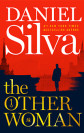
Your previous two novels, The Black Widow and House of Spies, dealt with the rise and fall of ISIS. In fact, your wildly popular hero, Gabriel Allon, personally eliminated ISIS’s top terrorist. But in The Other Woman, Gabriel is matched against the Kremlin and Russian intelligence. Why Russia? And why now?

Given the events of the last few months—in Syria and the United Kingdom, and in our own domestic politics as well—I think it was almost preordained that this year’s Gabriel Allon novel deal with the subject of Russia. I am a student of Russian and Soviet history, and I love writing about this new cold war in which we find ourselves. Simply put, the Russians are wonderful fictional villains. And that’s because they’re villains in real life, too.


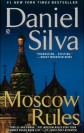
The first time you wrote about the new Russia was in Moscow Rules, a novel you released in 2008. I think it’s fair to say you were ahead of the curve in your dark depiction of Russia under Vladimir Putin. What did you see in the new Russia that the media and most of our politicians and diplomats missed?

I saw a man who, perhaps paradoxically, was building a fascist state and economy atop the rubble of the old communist Soviet Union. I also saw a man who was revanchist and paranoid at the same time, which is a profoundly dangerous combination. Mainly, I saw kleptomaniac who was more than willing to use murder as a tool of statecraft. The brave Russian journalists who dared to oppose Vladimir Putin were the first to die. They were the canaries in the coal mine.


Russia struck again, in the English cathedral town of Salisbury, while you were finishing The Other Woman. Something tells me you weren’t terribly surprised by the attempted assassination of Sergei Skripal.

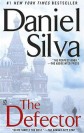
Actually, I wasn’t. The Russian intelligence services have long memories, and they never forget those who work with Russia’s adversaries against the motherland. I wrote about Putin’s determination to kill his political opponents outside Russia’s border in a novel called The Defector. But even I was stunned by the use of a military-grade nerve agent like Novichok. As a thriller writer, I’m permitted enormous license, but I would have never dreamed of using a weapon like that in a residential area. It boggles the mind. But this is the reality of the new Russia. Vladimir Putin doesn’t think the old rules and norms of international conduct apply to him, and he’s not going to abide by them. Look at the civil war in Syria. Putin’s ally, Bashar al-Assad, has repeatedly used chemical weapons against his own people, presumably with Moscow’s blessing, perhaps even with Moscow’s help.


What is Putin’s goal?

Simply put, it is the restoration of the old Russian-Soviet empire and destruction of the postwar global order. And the sooner we recognize that, the better. Putin is testing us to see whether we have the backbone to oppose him. He’s putting into practice Lenin’s infamous maxim: “Probe with bayonets. If you encounter mush, proceed; if you encounter steel, withdraw.” Thus far, Putin has encountered only mush.


What about the sanctions that the United Kingdom, the United States, and the European Union imposed on the Kremlin after the Skripal affair?

They were long overdue and a very good start, but I doubt they will be enough to deter Putin from his present course. Putin and Putinism are on the march. The strongman and the corporate state—by another name, fascism—are all the rage. Western-style democracy and the global institutions that created an unprecedented period of peace in Europe are suddenly out of vogue.


The opening sequence of The Other Woman reads like a scene from the darkest days of the Cold War. A defecting Russian spy is brutally assassinated in Vienna. But there’s a twist.

The defecting Russian spy is Gabriel Allon’s most important asset inside the SVR, Russia’s Foreign Intelligence Service, and his killing is staged to make it appear as though Gabriel is responsible. It creates an international firestorm that threatens his hold on the Office and leaves him no choice but to embark on an investigation into what went wrong. The inquiry leads him to the door of his old friend Graham Seymour, the chief of Britain’s Secret Intelligence Service, or MI6. Gabriel has some bad news for his old friend, that MI6 is harboring a Russian spy.


And Graham Seymour makes a fateful decision. He allows Gabriel to watch an MI6 officer to see if he’s in contact with the Russians.

Gabriel and Graham Seymour have an unusual relationship, to say the least. Graham allowed Gabriel to live for many years in the United Kingdom under an assumed identity, and they’ve worked together on several operations. They are as close as two spies from different services can possibly be.


Gabriel’s quest for the Russian spy takes him backward in time, to the twentieth century’s greatest act of treason. In 2016 you told the New York Times you had recently reread your entire collection of books on the Kim Philby affair in preparation for a forthcoming novel. Is it safe to assume The Other Woman was the novel you were referring to?

It is, actually. Kim Philby has been an obsession of mine for a very long time.


When did this Philby obsession start?

I suppose it began when I was twenty-two and I read My Silent War, Philby’s mendacious but utterly fascinating autobiography. It was written in Moscow under the watchful eye of the KGB, a few years after he defected. It’s quite a well-written book, which is hardly surprising given the fact Philby worked as a professional journalist for much of the time he was spying for the Soviet Union. I still can’t imagine how Philby betrayed his country the way he did, but he led one of the most extraordinary lives of the twentieth century. He was an active participant in the Spanish Civil War, World War II, and the Cold War, and his circle of friends and colleagues included a rather noteworthy writer named Graham Greene. Unfortunately, he betrayed them all, and a good many brave people died as a result.


Much of The Other Woman is set in Washington, where Philby lived and worked—and spied—from 1949 to 1951.

He also drank a great deal while he was in Washington, as did many of the early pioneers of the CIA. They were all spectacular boozers. Philby and his family lived in a large brick house on Nebraska Avenue that still stands today. When I lived in Washington, I passed the house several times a day, usually when I was picking up or dropping off my children at school. I used to imagine what it must have been like in those days. The drunken parties, the treachery, Guy Burgess living in the basement . . . If only those walls could talk.


You write in The Other Woman that Philby buried his miniature KGB camera and film in the Maryland countryside in 1951, after Guy Burgess and Donald Maclean defected to the Soviet Union. In fact, the buried loot plays an important role in the resolution of the story. First, is it true? And if so, is it still there?

It is indeed true that Philby buried his KGB paraphernalia that spring night in 1951, for the very simple reason he was afraid he was about to be exposed as a Soviet agent. Ben Macintyre, in his wonderful narrative history, A Spy Among Friends, wrote that Philby buried it in the woods along MacArthur Boulevard, near Old Angler’s Inn. In his own memoir, though, Philby was rather vague about the exact location. If I had to guess, the camera and film were probably unearthed during the construction of a new home without anyone noticing. But a part of me hopes it’s still out there somewhere.


Do you think there are any Russian moles inside MI6 or the CIA today?

If by the word “mole” you mean someone who penetrated MI6 or the CIA on orders from Moscow Center and burrowed his way into a position of power, I’d say the chances are remote. But that doesn’t mean the SVR hasn’t recruited assets inside the two most powerful intelligence services in the West. In fact, I’m quite confident they have.


Kim Philby spied out of his devotion to Marxism. What would motivate someone to spy for Vladimir Putin’s Russia?

Most spies betray their countries and their services for money. But some are forced into becoming spies through coerced recruiting methods. The Russians excel at burning and turning targets through so-called kompromat operations. The Russian intelligence operation in London and in Western Europe is truly massive. Security analysts estimate that two-thirds of the so-called diplomats stationed at a typical Russian embassy in Western Europe are actually intelligence officers. They’re not sitting around playing chess, they’re recruiting spies and running operations. For all of Putin’s bluster, Russia is economically and demographically weak. His intelligence services and cyberwarriors are important force multipliers.


This is the eighteenth novel in which Gabriel has appeared, and he’s a perennial #1 New York Times bestseller. But I read recently that you never intended for him to be a continuing character.

That’s true. Gabriel Allon was supposed to appear in one book and one book only, and then sail off into the sunset, never to be seen or heard from again. And now, seventeen additional books later, his story has come full circle. The morose, grieving man we first encountered in The Kill Artist has a new family and is the chief of the Israeli intelligence service. Obviously, I never imagined it would turn out this way.


How do you explain Gabriel’s popularity and longevity?

I think his essential appeal lies in the two very different sides of his character. He’s not just a brilliant intelligence operative, he’s one of the world’s finest art restorers as well. That combination of character attributes has allowed me to craft my stories in a way that makes them very different from most spy novels. As a result, I have many readers who might not typically pick up a novel of espionage. And I have Gabriel Allon to thank for that.


The Other Woman has wonderful settings, including Vienna, Strasbourg, Seville, and a quaint cottage in the English countryside that British intelligence uses as a safe house. Do you visit all the places you write about?

I typically try to spend as much time as possible in the places where my characters live and work. I’ve been inside the headquarters of the CIA and the KGB, I’ve ridden in the president’s limousine, and I’ve held a Leonardo in my hands at the Vatican. That said, some of my favorite scenes have been set in places where I’ve never set foot. The climax of Portrait of a Spy, for example, was set in the Empty Quarter of Saudi Arabia, where I’ve never been. A significant portion of The Black Widow took place in ISIS-controlled Syria and Iraq. Needless to say, I did not spend much time in the caliphate of the Islamic State.


What about Lock 10 on the Chesapeake & Ohio Canal, the setting for the climax of The Other Woman?

I took my wife there one afternoon by the exact route Gabriel uses in the novel. On the banks of the Potomac, next to an overturned rowboat and a large tree, I physically choreographed the final sequence of moves to produce the ending I wanted. The people watching me from the towpath of the canal probably thought I was either out of my mind or a practitioner of a new form of tai chi.


Can we talk a little about your writing process?

The word process implies something orderly and methodical. About the only thing procedural about my work is that once I start a book, I write every day, seven days a week, until it is done. When I’m approaching my deadline, I become a virtual hermit. I sometimes write twelve or fourteen hours a day.


Do you outline a book before you start writing?

I’ve tried outlining but it really doesn’t work for me. I find it much easier to simply carry the story and characters around in my head. I have three or four other books mentally blocked out as well, but much to my wife’s dismay I haven’t bothered to write them down.


The Other Woman is an enormously complex web of treachery and betrayal that reaches deep into history for its source material. Are you telling us you wrote it without an outline?

Yes. But that’s not to say that I didn’t have a pretty good idea of where I was going and how I intended to get there. I typically make adjustments as I press forward, rather like a painter applying a layer of obliterating paint and reworking a portion of the canvas. For better or worse, the revisions continue to the very end. I’ve been known to make changes to a book on the day it’s supposed to go to the printer.


You have other strange habits as well.

So I’m told.


You write in pencil on yellow legal pads.

I used to think it was odd, but I’ve discovered that many writers still do, including Nelson DeMille. I like the quiet and the pace of writing in longhand, and I rarely have to make revisions. Oftentimes, I can pick up one of my old legal pads—yes, I keep them all—and find pages and pages of finished copy with no edits.


I hear you’re picky about your pencils.

The Mirado Black Warrior by Paper Mate. I use the number 2. It’s an excellent pencil. Lately, I’ve rediscovered the joys of a good Dixon Ticonderoga.


And your legal pad?

The Signa by Staples. The paper is very smooth. It doesn’t wear down my pencils as quickly.


I assume you don’t turn in your books that way.

No, I’m not completely crazy. They’re typed into Microsoft Word, one chapter per file. My wife is my primary editor, and I employ two of my oldest friends as proofreaders. We are all quite maniacal about typographical errors. When one slips into the book, I’m always mortified.

Share